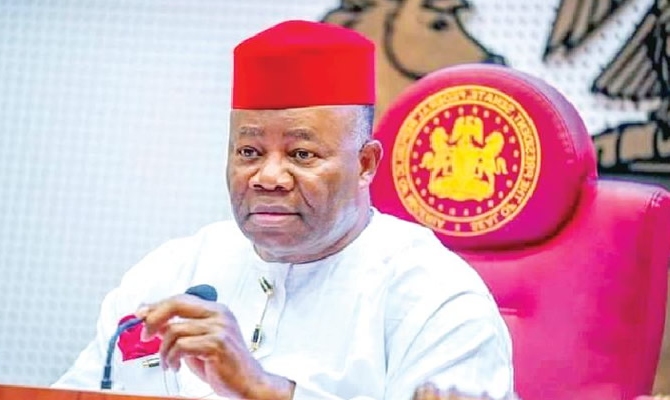
On Wednesday, in Abuja President Bola Tinubu appealed to the organised labour to avail him more time to consider their grievances before embarking on any nationwide strike.
This confirms the action that the Federal Government may enforce the court order restraining the organised labour from embarking on a strike over the withdrawal of fuel subsidy in May should the Nigeria Labour Congress make good its threat on August 2.
The Speaker of the House of Representatives, Tajudeen Abbas, disclosed Tinubu’s plea to State House Correspondents after leading some officers of the House to brief the President on the outcome of their engagement with the National Association of Resident Doctors, which has declared a nationwide strike.
At about the same time, following the threat by labour, the Federal Government on Wednesday evening held an emergency meeting with the organised labour comprising of the NLC and the Trade Union Congress at the Presidential Villa, Abuja.
But briefing reporters, Abbas said Tinubu appealed that being new in office, he needs time to evaluate the issues raised by workers over which as he is yet to be briefed.
Abbas said, “What he (Tinubu) said is that he’s just coming on board. We should ask them and beg them to please give him a little more time.
“The things that they mentioned, he is completely unaware of them, he is yet to be briefed about all those issues.
“But from what he heard from me, he also advised that we should channel some of those issues to the Chief of Staff to look at them one after the other. I believe the next coming days, some concerted actions will be taken.”
The Speaker explained that the House leadership invited NARD following their intention to go on strike, saying that the lawmakers succeeded in persuading the union to shelve the plan.
“Sequel to the meeting we had with them, there were series of conditions that they gave, that we felt we need to share with the President,” he revealed.
Asked what the House was doing to restrain the Nigeria Labour Congress from proceeding with the August 2 protests, Abbas said, “In the same manner, the same way, we will also invite them to come and sit so that we hear their grievances and then we follow the same pattern of engaging and persuading them to give us a little time so that we can be able to meet their expectations.”
Meanwhile, the House leadership’s meeting with the President was held as leaders of the NLC and the Trade Union Congress of Nigeria met with the Presidential Steering Committee on Palliatives set up by the Federal Government.
However, the meeting failed to convince the labour leaders to shelve their plan as they insisted on proceeding with the protest slated for August 2.
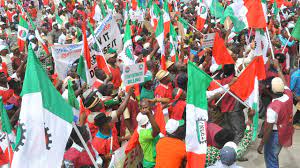
Wednesday’s meeting, which took place in the office of the President’s Chief of Staff, was attended by labour delegations led by the NLC President, Joe Ajaero and his TUC counterpart, Festus Osifo.
It was in continuation of the June 19 meeting over the initial increase of the petrol pump price to N520 per litre.
Addressing journalists after the meeting, Ajaero said, “We are going ahead with the protest because we have to be emphatic on what we put in our communique, to say we are commencing protests from August 2.”
On his part, the TUC President, Osifo, said both sides listened to the presentations from the Steering Committee secretariat and labour made its input afterwards.
He said, “Some of the things they presented, we did not agree with them. So, the areas we did not agree on, we also made our inputs known because when you come to such a meeting, it is for the government or its representatives to do a presentation.
“But it’s left for us to either agree or disagree. So, during the meeting, we gave them sufficient feedback. And they also agreed to go and look at those feedbacks and get back to us on Friday.”
However, the Special Adviser to the President on Energy, Olu Verheijen, said the discussions achieved some progress in negotiations.
She explained: “We’ve agreed to continue to make progress. It was a very productive meeting
On his part, Ifedayo Adedipe, SAN said the law must be obeyed unless it was set aside irrespective of the hardship in the country.
According to him, if the nation must progress, institutions and individuals must have respect for the rule of law.
He said, “If we must make progress, we must begin to respect our courts. Whatever the ruling of the court is, it must be obeyed unless it is set aside. If there is a subsisting judgment stopping NLC from going on strike, as a responsible body, the NLC must obey until that law is set aside. If Congress proceeds with a strike they might be walking a dangerous path.
“I agree there is hardship but disobeying court order is never the solution to the problem on the ground. If we don’t respect our laws, I am afraid we will not make progress. “
Adegoke Rasheed, SAN, said NLC leaders could be arrested for contempt if they proceeded with the strike.
“Until a judgment is set aside, it must be obeyed. It would be contempt of court for the NLC to disobey the court. If they do this and the court gets angry with them and orders the arrest of the leaders, the issue of human rights will not avail them. The order must be set aside before going on strike. The judges are passing through hardship too but everything must be done by the law. They have to tread with caution,” he said.
Another senior lawyer, Yomi Aliyu, SAN, also urged the NLC to obey the court order.
“They cannot go on strike if there is an extant order stopping them. The law should be respected. The FG should negotiate with them,” he advised.
CSOs react
Speaking on the NLC’s strike threat, the Executive Director, the Civil Society Legislative Advocacy Centre, Auwal Rafsanjani, stated that the masses could stage their protest despite a court order against the NLC, as it was their Constitutional right.
“If the government stops the NLC from embarking on a peaceful demonstration, that does not include other Nigerians. Other Nigerians who are victims of socio-economic hardship, they have the right to go on and protest, and also join any movement because the Constitution is very clear; it allows freedom of association and movement,” he said.
On his part, the Chairman, the Centre for Anti-Corruption and Open Leadership, Debo Adeniran, faulted the NLC’s seeming lack of commitment to embarking on the strike, noting that while the NLC was supposed to lead and trigger a mass protest, it appeared they weren’t interested in following through with it.
“It’s like the NLC has not been very forthcoming or doesn’t mean to go on strike, and the NLC is supposed to be a leader in the mass movement, not to be the sole actor. So, they are supposed to trigger a mass protest, but the way NLC goes about it, they don’t mean to continue the strike, Adeniran concluded.